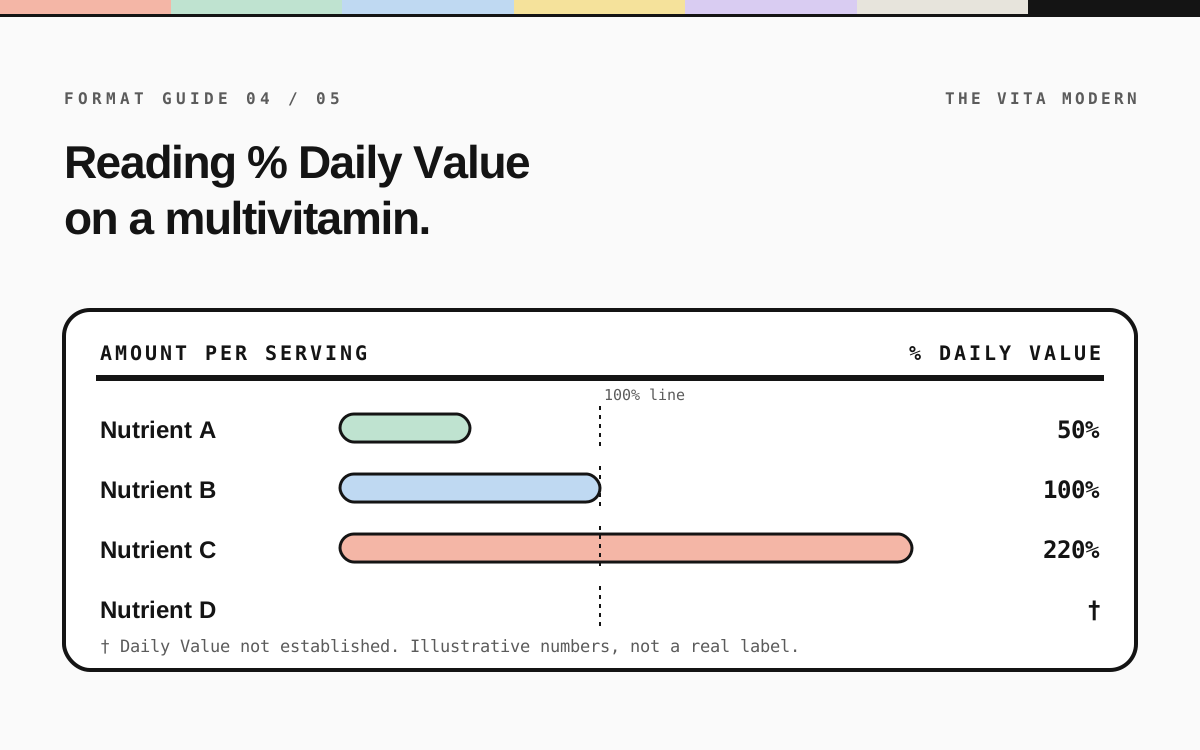
The % Daily Value column on a multivitamin tells you how much one serving contributes toward a single reference amount the FDA sets for each nutrient. It is a yardstick for comparing products, not a personal recommendation: a line that says 100% means the serving matches the FDA's reference number, not that it matches what you need.
Below, we explain what that reference is, why the column behaves the way it does, and then read one real panel, the Centrum Adults tablet, from top to bottom.
What the Daily Value is
The FDA describes Daily Values (DVs) as the recommended amounts of nutrients to consume or not to exceed each day, and the %DV as how much a nutrient in one serving contributes to that amount. Its own example: if the DV for a nutrient is 300 mcg and a serving has 30 mcg, the label shows 10%. As a general guide, the FDA calls 5% DV or less per serving low and 20% DV or more high.
On a supplement for adults, each nutrient has one DV, set for adults and children age 4 and older (separate DVs exist for infants, young children and pregnancy or lactation). The numbers come from the FDA's reference table; a few examples from it: vitamin C 90 mg, vitamin D 20 mcg, vitamin B12 2.4 mcg, iron 18 mg, calcium 1,300 mg, magnesium 420 mg.
One DV per nutrient, for most people over age 4. That makes the column good for comparing two bottles and poor for deciding what any one person needs.
Daily Value, RDA and upper limit are three different numbers
These three get mixed up constantly:
- Daily Value (DV): the FDA's single labeling reference per nutrient, used to calculate the percentage on the panel.
- Recommended Dietary Allowance (RDA): set by the Food and Nutrition Board; MedlinePlus defines it as the average daily intake enough to meet the needs of nearly all (97% to 98%) healthy people. RDAs vary by age and sex.
- Tolerable Upper Intake Level (UL): the maximum daily intake unlikely to cause adverse effects, per the NIH Office of Dietary Supplements (ODS); above it, the risk of harm rises.
Vitamin C shows the gap well. The DV is 90 mg. MedlinePlus lists the adult RDA as 90 mg for men and 75 mg for women, and says amounts above 2,000 mg a day are not recommended. A product can print 200% DV and still be far from the upper limit, or print a modest percentage for a nutrient where the limit is close.
The units in the amount column
Before comparing percentages, it helps to know that several nutrients use special units, all defined in federal rules (21 CFR 101.9):
- Vitamin A in mcg RAE (retinol activity equivalents): 1 mcg RAE equals 1 mcg retinol or 2 mcg of supplemental beta-carotene.
- Folate in mcg DFE (dietary folate equivalents): 1 mcg DFE equals 0.6 mcg of folic acid. When folic acid is added, its plain-mcg amount follows in parentheses. Our methylated guide covers this line in detail.
- Vitamin E in mg alpha-tocopherol.
- Niacin in mg NE (niacin equivalents).
- Vitamin D in mcg, with IU allowed only in parentheses after the mcg figure.
One panel, line by line: Centrum Adults
Serving size: 1 tablet. The panel has 26 vitamin and mineral lines, and every line below is copied from the Supplement Facts image on the Amazon listing we opened on September 30, 2026.
| Line on the panel | Amount | %DV | DV it is measured against |
|---|---|---|---|
| Vitamin A (29% as beta-carotene) | 1,050 mcg | 117% | 900 mcg RAE |
| Vitamin C | 60 mg | 67% | 90 mg |
| Vitamin D3 | 25 mcg (1,000 IU) | 125% | 20 mcg |
| Vitamin E | 13.5 mg | 90% | 15 mg alpha-tocopherol |
| Vitamin K | 25 mcg | 21% | 120 mcg |
| Thiamin / Riboflavin / Niacin | 1.5 mg / 1.7 mg / 20 mg | 125% / 131% / 125% | 1.2 mg / 1.3 mg / 16 mg NE |
| Vitamin B6 | 2 mg | 118% | 1.7 mg |
| Folate | 667 mcg DFE (400 mcg folic acid) | 167% | 400 mcg DFE |
| Vitamin B12 | 6 mcg | 250% | 2.4 mcg |
| Biotin / Pantothenic acid | 30 mcg / 10 mg | 100% / 200% | 30 mcg / 5 mg |
| Calcium | 200 mg | 15% | 1,300 mg |
| Iron | 18 mg | 100% | 18 mg |
| Phosphorus | 20 mg | 2% | 1,250 mg |
| Iodine | 150 mcg | 100% | 150 mcg |
| Magnesium | 50 mg | 12% | 420 mg |
| Zinc / Selenium | 11 mg / 55 mcg | 100% / 100% | 11 mg / 55 mcg |
| Copper | 0.5 mg | 56% | 0.9 mg |
| Manganese / Chromium / Molybdenum | 2.3 mg / 35 mcg / 45 mcg | 100% each | 2.3 mg / 35 mcg / 45 mcg |
| Chloride / Potassium | 72 mg / 80 mg | 3% / 2% | 2,300 mg / 4,700 mg |
What the column is telling you:
- The lines over 100% (vitamin A, D, the B vitamins, folate) are normal for a multi. The folate line is a good example of the units at work: 400 mcg of folic acid divided by 0.6 is about 667 mcg DFE, which is 167% of 400.
- The low lines are calcium (15%), magnesium (12%), phosphorus (2%), chloride (3%) and potassium (2%). ODS notes that multivitamins often contain only small amounts of calcium, magnesium and potassium, so a multi does not cover these the way it covers the vitamins.
- The order is fixed by regulation: vitamins A, C, D, E, K, the B vitamins, then choline, calcium, iron and the other minerals (21 CFR 101.36). That is why the lines look the same on every multi.
- What is missing can be deliberate or a matter of scale. Nutrients present at less than 2% of the reference amount are not declared at all (21 CFR 101.36).
When there is no percentage
Some lines carry a symbol, usually an asterisk or a dagger, instead of a number. Federal rules require it for any ingredient that has no DV, with a footnote reading "Daily Value not established" (21 CFR 101.36). It is not an omission. On the Thorne Basic Nutrients 2/Day panel, for example, gamma tocopherol (24 mg), boron (2 mg) and lutein (140 mcg) all carry a symbol in place of a percentage. Fish-oil panels do the same for omega-3s: Nordic Naturals prints a dagger beside EPA and DHA.
A serving of more than one piece changes the heading, not the math. The rules allow a heading such as "Amount Per 2 Tablets" in place of "Amount Per Serving" (21 CFR 101.36), and Thorne's serving is two capsules, so every amount and percentage on that panel is for two capsules.
Three multis side by side
| Format | Product (serving) | Vitamin D | B12 | Iron | Calcium |
|---|---|---|---|---|---|
| Tablet | Centrum Adults (1 tablet) | 25 mcg, 125% | 6 mcg, 250% | 18 mg, 100% | 200 mg, 15% |
| Tablet | Nature Made Multi with Iron (1 tablet) | 25 mcg, 125% | 6 mcg, 250% | 18 mg, 100% | 160 mg, 12% |
| Capsule | Thorne Basic Nutrients 2/Day (2 capsules) | 50 mcg, 250% | 600 mcg, 25,000% | Not listed | 52 mg, 4% |
The two tablets are close to twins on these lines. The capsule multi goes much higher on several vitamins and has no iron line at all, a reminder that "multivitamin" is not a standard recipe.
Why stacking products doubles up
The percentages on two products simply add. ODS points out that some multis contain amounts above the DV, and some even above the UL, and that upper limits for iron include every source, food and supplements together. Three examples using panels from our organizer (arithmetic only, not a suggestion to combine them):
- Centrum plus Nature Made: 36 mg of iron, against an adult UL of 45 mg (ODS), before counting food.
- Centrum plus one NOW D3 & K2 capsule: 50 mcg of vitamin D (250% DV), half the adult UL of 100 mcg (MedlinePlus).
- Centrum plus Nature Made: 800 mcg of folic acid, against a UL of 1,000 mcg for synthetic folate (ODS), before counting fortified foods.
Reading any panel, top to bottom
Serving size
Note how many pieces the amounts refer to ("Serving Size 1 Tablet," "Amount Per 2 Tablets").
Amount and unit on each line
Watch for mcg RAE, mcg DFE, mg alpha-tocopherol and mcg with IU in parentheses.
The %DV beside it
Use 5% as low and 20% as high for quick comparisons, per the FDA.
The parentheses
They show the form (for example, "as cyanocobalamin") and, for folate, any added folic acid.
Symbols and footnotes
An asterisk or dagger with "Daily Value not established" means no DV exists for that ingredient.
Other ingredients and warnings
Below the box: the fillers, coatings and colors, plus the boxed iron warning if the product has iron.
- Compare two products at the same number of servings you would actually take.
- Add every product's lines together before comparing to any upper limit.
- A high %DV is not a quality score, and a low one is not a defect.
A Daily Value is a labeling tool, not a prescription. If you take medications, are pregnant or nursing, or are choosing for a child, ask a clinician or pharmacist how a product fits. Keep any multivitamin with iron out of children's reach; its label warning exists for a reason.
Sources
- U.S. Food and Drug Administration. Daily Value on the Nutrition and Supplement Facts labels (definitions, 5%/20% guide, full DV table; content current as of 03/05/2024). link
- U.S. Food and Drug Administration. Dietary Supplement Labeling Guide (April 2005), including its appendices of Daily Values for adults and children 4 or more years of age and for infants, young children and pregnant or lactating women. link
- Electronic Code of Federal Regulations. 21 CFR 101.36, nutrition labeling of dietary supplements (order of nutrients, "Daily Value not established," 2% threshold). link
- Electronic Code of Federal Regulations. 21 CFR 101.9 (reference daily intakes and units: RAE, DFE, alpha-tocopherol, NE). link
- MedlinePlus (U.S. National Library of Medicine). Vitamins (RDA definition) and Vitamin C (RDAs and 2,000 mg ceiling). Reviewed 1/21/2025. Vitamins, Vitamin C
- MedlinePlus. Vitamin D (adult upper limit of 100 mcg). Reviewed 1/21/2025. link
- NIH Office of Dietary Supplements. Multivitamin/mineral supplements, health professional fact sheet (updated July 17, 2024), read via the Internet Archive copy of Sep 26, 2026 because the live site blocked automated access. link
- NIH Office of Dietary Supplements. Iron, consumer fact sheet (updated August 17, 2023; upper limits from all sources), Internet Archive copy of Sep 29, 2026. link
- NIH Office of Dietary Supplements. Folate, health professional fact sheet (updated November 30, 2022; UL for synthetic folate), Internet Archive copy of Sep 29, 2026. link
- Amazon listings and Supplement Facts images opened Sep 30, 2026: Centrum Adults (B09BVYY7XR), Nature Made Multi with Iron (B00YMSLT88), Thorne Basic Nutrients 2/Day (B00FOTMGTU), NOW Vitamin D-3 & K-2 (B0019QT9LA), Nordic Naturals Ultimate Omega (B002CQU54Q). As an Amazon Associate we earn from qualifying purchases.
This article is educational and is not medical advice. Statements about dietary supplements have not been evaluated by the Food and Drug Administration. Ask a qualified clinician or pharmacist before starting or changing a supplement, especially if you have an existing condition or take medication.