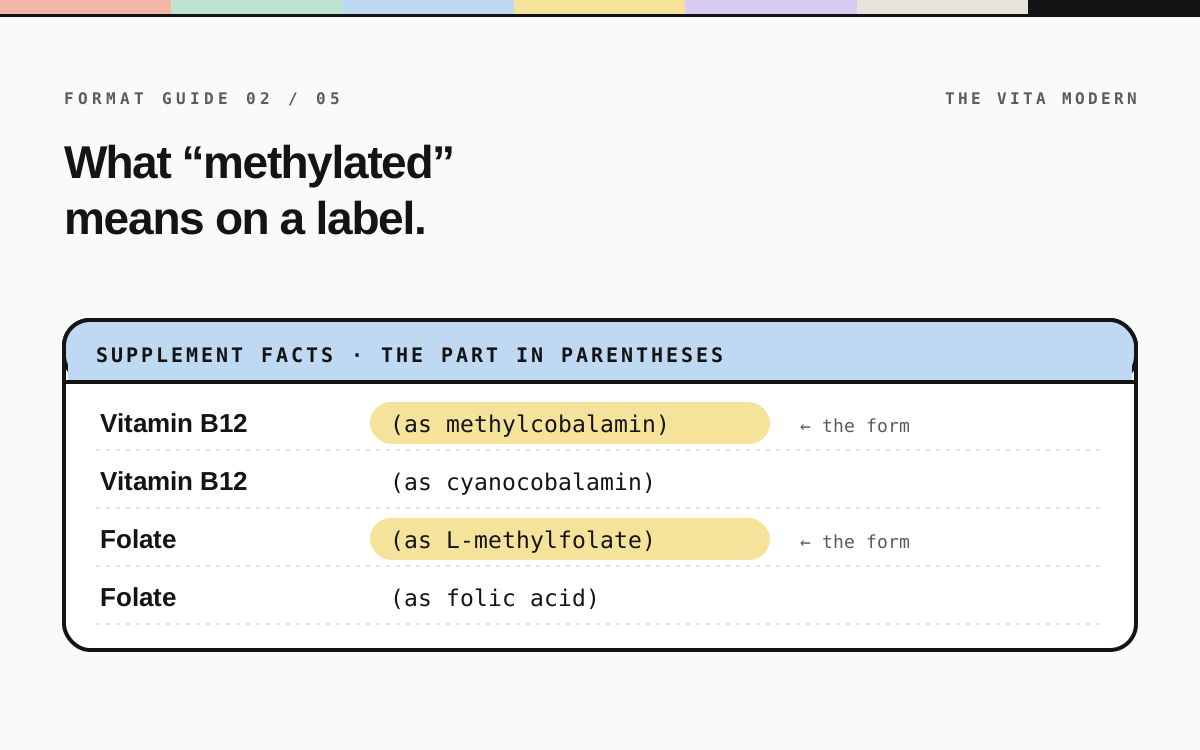
On a supplement label, "methylated" is shorthand for two ingredient choices: vitamin B12 supplied as methylcobalamin instead of cyanocobalamin, and folate supplied as L-5-methyltetrahydrofolate (methylfolate) instead of folic acid. The word describes the chemical form in the bottle. It does not, by itself, tell you that a product is better for you, and the NIH Office of Dietary Supplements states plainly that no evidence shows B12 absorption from supplements varies by form.
The form is always printed in parentheses after the nutrient name on the Supplement Facts panel ("Vitamin B12 (as methylcobalamin)"). Once you know where to look, you can read it on any bottle in thirty seconds.
Vitamin B12: four forms, one vitamin
The NIH Office of Dietary Supplements (ODS) describes vitamin B12 as a family of cobalt-containing compounds called cobalamins. Two of them, methylcobalamin and 5-deoxyadenosylcobalamin (often shortened to adenosylcobalamin), are the forms the body's enzymes actually use. The other two, hydroxocobalamin and cyanocobalamin, become active after the body converts them into one of the first two.
Cyanocobalamin is the form most often found in supplements, according to ODS. A 2022 review of B12 in foods, supplements and medicines (Temova Rakuša and colleagues, Molecules) explains why: cyanocobalamin is the most stable of the four forms, which makes it easier to manufacture and store. The same review notes that manufacturers have been shifting toward methylcobalamin in recent years.
What about absorption? The two sources we read line up on the main point, with some nuance:
- ODS (fact sheet updated July 2, 2025): "No evidence indicates that absorption rates of vitamin B12 in supplements vary by form of the vitamin."
- The 2022 review: for most people the bioavailability of all four forms "is considered comparable," though it also describes a growing body of research reporting lower tissue retention and higher urinary loss for cyanocobalamin than for the other three forms.
In other words, the research does not hand a clear winner to either form for the general population, and a label that says "methyl" is describing an ingredient choice, not a measured outcome.
Whatever form you swallow, ODS and the 2022 review both describe the body converting B12 into the same working forms inside cells. "Active form" on a label is chemistry, not a promise.
Why B12 lines run to thousands of percent
The Daily Value for vitamin B12 is 2.4 mcg (FDA), which is also the adult RDA listed by MedlinePlus. That is why a single-nutrient B12 product shows an eye-watering percentage: the Jarrow Methyl B-12 chewable lists 1,000 mcg of methylcobalamin per tablet and 41,667% DV. The Thorne Basic Nutrients 2/Day capsules list 600 mcg per two-capsule serving (25,000% DV).
ODS explains the large doses. About 56% of a 1 mcg oral dose is absorbed, but absorption drops drastically once the capacity of intrinsic factor (reached at 1 to 2 mcg) is exceeded: about 2% at 500 mcg and 1.3% at 1,000 mcg. By that estimate, a 1,000 mcg tablet delivers roughly 13 mcg. ODS also notes that multivitamins typically contain 5 to 25 mcg of B12, while B12-only supplements typically contain 500 to 1,000 mcg. No Tolerable Upper Intake Level (UL) has been set for vitamin B12, because it is generally considered safe even at high doses (ODS).
Folate: folic acid, methylfolate and the DFE unit
MedlinePlus defines folate as the B vitamin (B9) found naturally in foods, and folic acid as the man-made form used in supplements and fortified foods. ODS lists the other names you will see for the methylated form: 5-MTHF, L-5-MTHF, 5-methyl-folate, L-methylfolate and methylfolate. 5-MTHF is also the main form of folate circulating in blood.
The label does not count folate in plain micrograms. It uses mcg DFE (dietary folate equivalents), a unit the Food and Nutrition Board created because folic acid is absorbed better than food folate. ODS gives the numbers: at least 85% of folic acid taken with food is absorbed, against about 50% of the folate naturally in food, so 1 mcg DFE equals 0.6 mcg of folic acid taken with food. The FDA's Daily Value for folate is 400 mcg DFE.
Federal rules then fix how the line is printed (21 CFR 101.9): the nutrient is always named "Folate" and given in mcg DFE, and if folic acid was added, its amount appears in parentheses in plain mcg. The rule counts synthetic forms such as the calcium salt of L-5-MTHF under the "Folate" name too. The FDA's consumer page explains that if any of the folate comes from folic acid, that amount is listed in mcg in parentheses, which gives a handy test: a folate line with no "(mcg folic acid)" means no folic acid was added.
For methylfolate, ODS says its bioavailability is the same as or greater than that of folic acid, but that conversion factors between mcg and mcg DFE for 5-MTHF "have not been formally established." FDA allows manufacturers to use a factor of 1.7, the same as folic acid, or their own factor, as long as it does not exceed 1.7. Thorne's panel shows exactly that math: 400 mcg of L-5-methyltetrahydrofolate listed as 667 mcg DFE (400 × 1.7 ≈ 667).
How the forms appear on labels in our organizer
| Format | Product | B12 line | Folate line |
|---|---|---|---|
| Tablet | Jarrow Methyl B-12 (chewable) | 1,000 mcg as methylcobalamin (41,667% DV) | None (B12-only product) |
| Capsule | Thorne Basic Nutrients 2/Day (2 capsules) | 600 mcg as methylcobalamin (25,000% DV) | 667 mcg DFE from 400 mcg L-5-methyltetrahydrofolate (167% DV) |
| Gummy | SmartyPants Adult Multi & Omegas (3 gummies) | 3.6 mcg as methylcobalamin (150% DV) | 375 mcg DFE as Ca 5-methylfolate (94% DV); no folic acid in parentheses |
| Tablet | Centrum Adults (1 tablet) | 6 mcg (250% DV); ingredients list cyanocobalamin | 667 mcg DFE (400 mcg folic acid) (167% DV) |
| Tablet | Nature Made Multi with Iron (1 tablet) | 6 mcg as cyanocobalamin (250% DV) | 665 mcg DFE (400 mcg folic acid) (166% DV) |
Two things stand out. First, "methylated" shows up across formats: a chewable, a capsule and a gummy. Second, the percentages that matter for comparing products come from the same DFE and DV arithmetic whatever the form, so a folic-acid multi and a methylfolate multi can print the same 167%.
The trade-off nobody prints: light and stability
The same 2022 review that explains cyanocobalamin's popularity also explains a weakness of the methylated form. All four B12 forms break down in light, and methylcobalamin and adenosylcobalamin are especially sensitive. In one study the review cites, six commercial methylcobalamin tablets and capsules lost between 5% and 31% of their B12 after 20 days of light exposure while still in their original packaging, and between 8% and 44% once opened, depending on the packaging and the tablet coating. That is a lab exposure test, not a prediction for your kitchen, but it is a good reason to keep a methyl B12 product in its own bottle, closed, and away from a sunny windowsill. Jarrow's label asks for storage "in a cool, dry place." Our storage guide covers the rest.
Reading the B12 and folate lines, step by step
On a multivitamin, the order of nutrients is fixed by regulation, with folate and then B12 following vitamin B6, so both lines sit together in the middle of the panel.
Find the B12 line and its parentheses
"(as methylcobalamin)" or "(as cyanocobalamin)." If the panel gives no form, check the other-ingredients list, where Centrum names cyanocobalamin.
Compare the amount with 2.4 mcg
That is the Daily Value. Remember that absorption drops sharply at high single doses (ODS), so a larger number is not a linear increase.
Read the folate line in mcg DFE
This is the figure to compare between products, since every label uses the same unit.
Look for "(mcg folic acid)"
Present: folic acid was added, and that plain-mcg number is what counts toward the folic acid upper limit. Absent: the folate comes from another form, such as methylfolate.
Add up across everything you take
ODS lists a UL of 1,000 mcg a day for synthetic folate from supplements and fortified foods, measured in mcg, not mcg DFE (1,000 mcg of folic acid equals 1,667 mcg DFE).
- "Methyl," "active," "bioactive" and "methylated" describe the form, not a tested result.
- A B12-only product and a multi with B12 can overlap; the multi alone often covers the Daily Value.
- Chewable B12 tablets often use a sugar alcohol: Jarrow's lists xylitol first among its other ingredients.
- Keep light-sensitive forms in the original closed bottle.
MedlinePlus advises most adults to stay at or under 1,000 mcg a day of folic acid and to check the right dose with a provider, partly because high intakes can hide a low B12 status. Folate also interacts with some medicines; ODS names methotrexate, for example, as a folate antagonist. If you take any prescription medicine, are pregnant or planning to be, or are choosing for a child, ask a clinician or pharmacist which form and amount make sense. A label cannot decide that for you.
Sources
- NIH Office of Dietary Supplements. Vitamin B12, health professional fact sheet (updated July 2, 2025), read via the Internet Archive copy of Sep 29, 2026 because the live site blocked automated access. link
- NIH Office of Dietary Supplements. Folate, health professional fact sheet (updated November 30, 2022), read via the Internet Archive copy of Sep 29, 2026. link
- Temova Rakuša Ž, Roškar R, Hickey N, Geremia S. Vitamin B12 in foods, food supplements, and medicines: a review of its role and properties with a focus on its stability. Molecules. 2022;28(1):240. PMID: 36615431. link
- MedlinePlus (U.S. National Library of Medicine). Vitamin B12. Reviewed 1/21/2025. link
- MedlinePlus. Folic acid in diet. Reviewed 2/3/2025. link
- U.S. Food and Drug Administration. Daily Value on the Nutrition and Supplement Facts labels (DV table, including folate in mcg DFE and B12 at 2.4 mcg). link
- U.S. Food and Drug Administration. Folate and folic acid on the Nutrition and Supplement Facts labels. link
- Electronic Code of Federal Regulations. 21 CFR 101.9 (folate declared in mcg DFE; folic acid in parentheses; DFE definition). link
- Electronic Code of Federal Regulations. 21 CFR 101.36 (order of vitamins on a Supplement Facts panel; source ingredients in parentheses). link
- Amazon listings and Supplement Facts images opened Sep 30, 2026: Jarrow Methyl B-12 chewable (B002FJW3ZY), Thorne Basic Nutrients 2/Day (B00FOTMGTU), SmartyPants Adult Multi & Omegas (B0F2KG28P5), Centrum Adults (B09BVYY7XR), Nature Made Multi with Iron (B00YMSLT88). As an Amazon Associate we earn from qualifying purchases.
This article is educational and is not medical advice. Statements about dietary supplements have not been evaluated by the Food and Drug Administration. Ask a qualified clinician or pharmacist before starting or changing a supplement, especially if you have an existing condition or take medication.