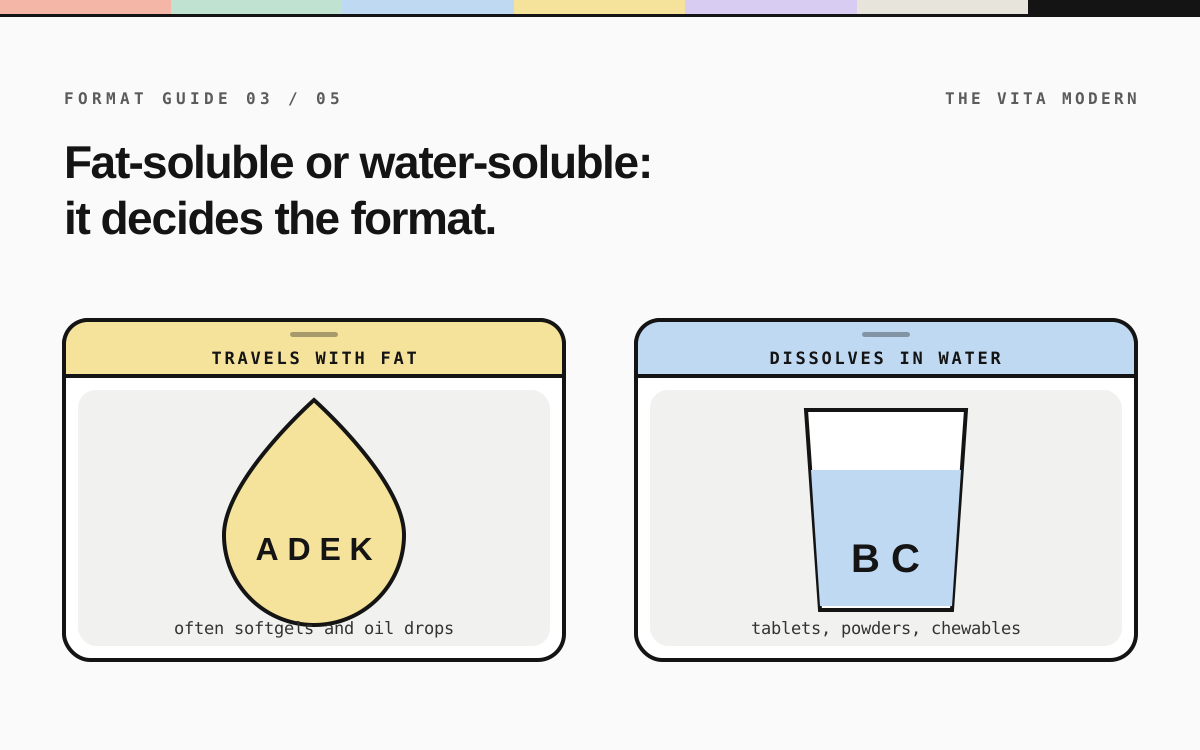
There are 13 essential vitamins, and MedlinePlus sorts them into two groups. Four of them, vitamins A, D, E and K, are fat-soluble: they are absorbed more easily when dietary fat is present and are stored in the liver, fatty tissue and muscles. The other nine, vitamin C and the eight B vitamins, are water-soluble: the body does not store them (with one notable exception) and passes leftover amounts in urine.
That split explains a surprising amount about what you see on a supplement shelf, from vitamin D sold in a dropper of oil to vitamin C sold as a jar of crystals. It also explains why the upper limits on a label matter more for some vitamins than others.
The two groups, and the exception
According to MedlinePlus:
- Fat-soluble (A, D, E, K): stored in the body's liver, fatty tissue and muscles, and absorbed more easily in the presence of dietary fat.
- Water-soluble (C, thiamin, riboflavin, niacin, B6, pantothenic acid, biotin, folate, B12): not stored; excess leaves in urine, so they have to be taken in regularly.
- The exception: vitamin B12 is water-soluble, but the liver can store it for years. MedlinePlus puts it at "a few years' worth" of the amount the body needs.
The NIH Office of Dietary Supplements (ODS) adds useful detail for two of the fat-soluble vitamins. For vitamin D, fat eaten at the same time enhances absorption, "but some vitamin D is absorbed even without dietary fat." For vitamin K, it describes absorption along the same route as dietary fats, and notes that compared with the other fat-soluble vitamins, very little vitamin K circulates in the blood because the body metabolizes and excretes it quickly.
"Stored" cuts both ways. It means the body keeps a reserve, and it also means large supplement doses can build up. MedlinePlus asks people to be very careful with large amounts of vitamin A, D, E and K supplements for exactly that reason.
How solubility shows up in the format
A vitamin's solubility does not dictate its format, but it does make some formats natural. Here is how the entries in our organizer line up:
| Format | Product | What is in it | Carrier, per the label |
|---|---|---|---|
| Liquid | Carlson Super Daily D3 | Vitamin D3 (cholecalciferol), 25 mcg (1,000 IU) per drop | Medium chain triglyceride oil (from coconut); one drop is 0.028 mL |
| Capsule | NOW Vitamin D-3 & K-2 | D3 25 mcg (1,000 IU) and K2 as MK-4, 45 mcg, per capsule | Dry powder: rice flour in a hypromellose (plant cellulose) capsule |
| Softgel | Nordic Naturals Ultimate Omega | Fish oil, 1,280 mg omega-3s per 2 softgels (fats, not vitamins) | Gelatin softgel; vitamin E (RRR-alpha tocopherol) added as an antioxidant |
| Powder | NOW Vitamin C Crystals | Ascorbic acid, 1,100 mg per 1/4 level teaspoon (1.1 g) | Nothing: "Other ingredients: None" |
| Tablet | Jarrow Methyl B-12 | B12 (methylcobalamin), 1,000 mcg per chewable | Xylitol, cellulose and other tableting ingredients |
The pattern is loose, and the table shows why. Carlson dissolves its vitamin D in oil and sells it by the drop, which suits a vitamin that mixes with fat. NOW puts the same 1,000 IU of D3 in a dry capsule. ODS describes fat in the gut at the same time as what enhances vitamin D absorption, and says some is absorbed even without it; it does not say the vitamin has to arrive dissolved in oil. Fish oil is a softgel because it is an oil, and a softgel is the tidy way to swallow one. Vitamin C, which dissolves in water, is sold by NOW as a plain powder you stir into a drink.
ODS also flags a limit on large water-soluble doses: about 70% to 90% of vitamin C is absorbed at moderate intakes of 30 to 180 mg a day, but above 1 gram a day absorption falls below 50%, and the unused vitamin is excreted in urine. A single 1/4-teaspoon serving of the NOW crystals (1,100 mg) is already past that 1-gram mark.
Stored vs. not stored: where upper limits come in
A Tolerable Upper Intake Level (UL) is the most you can take daily with little risk of harm. The figures below are for adults and come from the government pages we opened; the last column says what each one covers.
| Vitamin | Soluble in | Adult upper limit | What the source adds |
|---|---|---|---|
| Vitamin D | Fat | 4,000 IU (100 mcg) a day, age 9 and up | MedlinePlus: toxicity almost always comes from too many supplements; 1 mcg of D3 equals 40 IU. |
| Vitamin E | Fat | 1,000 mg a day from supplements | MedlinePlus: equal to 1,500 IU of natural or 1,100 IU of synthetic vitamin E; high-dose supplements might raise bleeding risk. |
| Vitamin A | Fat | 3,000 mcg a day of preformed vitamin A | Institute of Medicine DRI report: the UL applies to preformed vitamin A (retinol and its esters). MedlinePlus adds that chronic poisoning may occur in adults who regularly take more than 33,000 IU a day, and that children are more sensitive. |
| Vitamin K | Fat | None established | ODS: no UL because of low potential for toxicity; the concern is medication interactions (below). |
| Vitamin C | Water | 2,000 mg a day | MedlinePlus: higher amounts can cause stomach upset and diarrhea. |
| Vitamin B12 | Water (stored) | None established | ODS: generally considered safe even at high doses. |
| Folate | Water | 1,000 mcg a day of synthetic folate | ODS: applies to folic acid and other synthetic forms from supplements and fortified foods, not food folate. |
So "water-soluble means harmless" is not quite right either. Vitamin C and folic acid both have limits, and MedlinePlus's general page on vitamins puts it bluntly: many people think that if some is good, a lot is better, "This is not always the case."
Taking them with food: what the labels say
Because fat helps absorb the fat-soluble group, you might expect every label with A, D, E or K to say "take with a meal." Many do, in their own words:
- Centrum Adults: "Take one (1) tablet daily with food."
- Nature Made Multi with Iron: "take 1 tablet daily with water and a meal."
- Nordic Naturals Ultimate Omega (softgels and gummy chews): two daily, "with food."
- Carlson Super Daily D3: one drop daily, which "May be put in food or a drink."
- NOW Vitamin C Crystals: "Mix 1/4 level teaspoon daily in juice or water."
We are reporting the directions, not adding to them. If you are unsure when to take something, the label's direction and your pharmacist are better guides than a general rule.
Vitamin K and blood thinners
This is the fat-soluble interaction government sources single out. ODS explains that warfarin (Coumadin) and similar anticoagulants work against vitamin K, and that people taking them need to keep their vitamin K intake from food and supplements consistent, because sudden changes can strengthen or weaken the drug's effect. The NOW D3 & K2 capsule supplies 45 mcg of K2 as MK-4; many multivitamins carry vitamin K too (Centrum lists 25 mcg, Nature Made 80 mcg, Thorne 400 mcg). ODS also notes that supplements use K1 (phylloquinone or phytonadione) or K2 as MK-4 or MK-7, and that few data compare how well the forms are absorbed.
Adding up fat-soluble vitamins across products
Stacking products is where upper limits become real, so it helps to add the lines in order.
List every product you take
Include multis, single vitamins, gummies and drops. Fortified foods count toward the UL too.
Copy the A, D, E and K lines
Use the amount per labeled serving, multiplied by the number of servings you actually take.
Put them in the same unit
Vitamin D appears in mcg with IU optional in parentheses; 1 mcg of D3 equals 40 IU (MedlinePlus).
Compare the totals with the limits
For example, Centrum (25 mcg D3) plus one NOW D3 & K2 capsule (25 mcg) totals 50 mcg, half the adult UL of 100 mcg.
Take the list to a pharmacist
Especially if vitamin K is on it and you take any prescription medicine.
- Softgels and oil drops are convenient for fat-soluble vitamins, not required.
- A powder lets you measure large water-soluble doses easily, which is a reason to measure carefully.
- "Stored" vitamins (A, D, E, K, and B12) deserve the closest look when you combine products.
Upper limits are ceilings, not targets, and the right amount for you depends on your diet, health and medicines. If you take a blood thinner or any other prescription drug, are pregnant or nursing, or are choosing for a child, ask a clinician or pharmacist before adding a supplement.
Sources
- MedlinePlus (U.S. National Library of Medicine). Vitamins. Reviewed 1/21/2025. link
- MedlinePlus. Vitamin D (upper limits; 1 mcg D3 = 40 IU). Reviewed 1/21/2025. link
- MedlinePlus. Vitamin A. Reviewed 1/21/2025. link
- MedlinePlus. Vitamin E. Reviewed 1/21/2025. link
- MedlinePlus. Vitamin C. Reviewed 1/21/2025. link
- MedlinePlus. Vitamin B12. Reviewed 1/21/2025. link
- NIH Office of Dietary Supplements. Vitamin D, health professional fact sheet (updated June 27, 2025), read via the Internet Archive copy of Sep 29, 2026 because the live site blocked automated access. link
- NIH Office of Dietary Supplements. Vitamin K, health professional fact sheet (updated March 29, 2021), Internet Archive copy of Sep 27, 2026. link
- NIH Office of Dietary Supplements. Vitamin C, health professional fact sheet (updated July 31, 2025), Internet Archive copy of Sep 25, 2026. link
- NIH Office of Dietary Supplements. Vitamin B12 (updated July 2, 2025) and Folate (updated November 30, 2022) health professional fact sheets, Internet Archive copies of Sep 29, 2026. B12, folate
- Institute of Medicine (National Academies). Dietary Reference Intakes for Vitamin A, Vitamin K, Arsenic, Boron, Chromium, Copper, Iodine, Iron, Manganese, Molybdenum, Nickel, Silicon, Vanadium, and Zinc (2001), chapter 4, vitamin A: adult UL of 3,000 mcg a day of preformed vitamin A. link
- Amazon listings and label images opened Sep 30, 2026: Carlson Super Daily D3 (B0062QD5LM), NOW Vitamin D-3 & K-2 (B0019QT9LA), Nordic Naturals Ultimate Omega (B002CQU54Q), NOW Vitamin C Crystals (B00028LX1U), Jarrow Methyl B-12 (B002FJW3ZY), Centrum Adults (B09BVYY7XR), Nature Made Multi with Iron (B00YMSLT88), Thorne Basic Nutrients 2/Day (B00FOTMGTU). As an Amazon Associate we earn from qualifying purchases.
This article is educational and is not medical advice. Statements about dietary supplements have not been evaluated by the Food and Drug Administration. Ask a qualified clinician or pharmacist before starting or changing a supplement, especially if you have an existing condition or take medication.